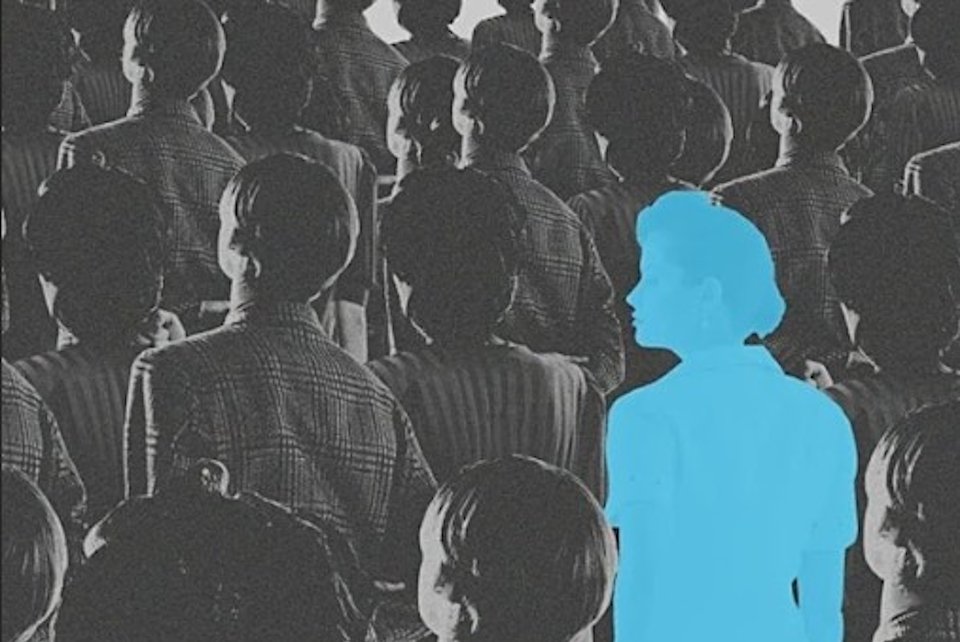
Last year, on suicide prevention day, our college held a Symposium where one speaker repeatedly insisted that “Mental health is political”. This caused a little bit of an argument on the stage. One voice went “You can’t bring politics into everything”. The argument slowly turned into a 2v1 WrestleMania, with one of the chief guests knocking the speaker down with 10 seconds to admit defeat. That… was a lie but it sure did turn into absolute chaos. One side argued that the police re-traumatized them and that the system is basically useless. and on the other side the speaker argued the exact same thing except that he used the word ‘politics’ while talking about mental health and suicide which set off a red alarm.
Politics in Psychology might not always be as clear as day – sometimes it peeks through the surface in moments like this. Sometimes it dresses up itself as a harmless disagreement, a joke, or a threat whenever someone brings up the term ‘Politics’ – when in reality it’s the privilege to call ourselves ‘Apolitical’.
No matter how much we, as someone in the field of psychology, try and turn our heads away, Politics will still follow us around like Joe Goldberg. Here are some of the political elements in Psychology that I have noticed and I believe are worth keeping in mind – backed with scientific research papers, books that I’ve read, and most important of all, my shower thoughts.
The politics of the very definition of ‘normal’
If there’s one takeaway for me from Sally Rooney’s (in)famous ‘Normal People’, it’s that none of the characters in the book were normal. So what is it? “Normal”? And on the other end of the spectrum, what is insanity? What is the criteria of being a sane person? And who determines that?
What we call now as the symptoms of anxiety/anxiety attack, were once called ‘Female Hysteria’ associated only with women.
What we call ‘Resistance against an oppressive system’ was once called insanity by the white folks of the 19th century to justify enslavement of black people.
‘Drapetomaniac’, ‘Dysaesthesia aethiopica’ were some of the many terms used for pathologizing black resistance.
The definition of normal has always been a product of time. Western Psychology as a field has a very long history of changing the criteria for what’s normal – what’s the right way to be “human”.
So is anybody ever really ‘normal’? Could anybody ever be? And isn’t the term ‘Abnormal Psychology’ in itself a little… deceptive?
“An abnormal reaction to an abnormal situation is normal behavior” says Viktor Frankl
If this is true, when the world is literally on fire, doesn’t normal seem a little abnormal? Or like blissful ignorance?
So the next time we term a behaviour ‘normal’ or’ abnormal’, we should probably take a step back and think about who’s criteria is it by.
Female Psychologists in textbooks
Close your eyes and think of 10 prominent psychologists that you know.
If you’ve already read the title of the section, you either presumed what it’s about and ignored it, or you added a few female psychologists in there for diversity purposes. Either way, the question remains, why are there fewer female psychologists than male in Psychology textbooks? Well, for starters, probably because they were busy fighting witch allegations (and were denied so many academic rights). But even when they are taught about, they are represented as neo-freudians (as someone who agreed or disagreed with Freud) and not as minds of their own.
Sure, history is important, in fact, it’s the most important thing to learn about. But like my dear friend Maryam pointed out “Why are psychology academic books predominantly just a historical document of white men sayings and their theories that have negligent scientific backings instead of a working guide on how to actually help our clients?” Period. Clap emoji.
Who gets included in the textbooks is not accidental, it’s a calculated academic decision.
Men wrote the textbooks.
Men decided the curriculum.
Men decided who counted as a “father” of psychology.
A lean towards individualism
I’m going to sound very millennial when I say this but we’re in an era of extreme hyper-individualism – to a point, where it’s more destructive than helpful. The terms ‘Self-Care’ and ‘Self-Love’ are disguised as mental health terms where we see ‘Self’ as the most important thing, while we collectively ignore community.
It’s not shocking news when I say Self-care has been weaponized big time – one, to turn a blind eye to the state of the world. two, to make you feel good about doing it.
This is not to say you shouldn’t prefer spending time with yourself at all – but notice how most self-care and self-love activities isolate us – “cut people off” “Put yourself first” “If they don’t help you grow, they’re not your people” – even though we’re social beings and our nervous systems are built for co-regulation and shared meaning-making (Insert Doakes from Dexter meme)
Now, if a mental health professional is reading this, maybe it’s time we incorporate community- or collectivism-based interventions instead of relying solely on therapeutic relationships as an inter-relational correction process.
Diagnosis
“I’m cringing at this new DSM. How can someone trust a manual that is pathologizing bereavement?” – not me.
This was asked by Dr. Roger McIntyre, a psychiatry and pharmacology professor at the University of Toronto.
There’s a guy on Instagram ,@zuckerabudi who says “Look at what’s behind me and now without labelling it with a name, describe what it is” – For the first few seconds you’ll go “oh it’s a pond”, and then when you dissociate it with its name, you’ll see the pond like you’re seeing one for the first time, You’ll wonder about its depth and what it would be like to feel it with your hands, how cold it would be. I wonder how many things we’ve ruined because we named it.
Now imagine something as complex as a human behavior labelled with a diagnosis.
Linguistic manipulation has been a tool for marginalisation and categorisation for a very long time and a diagnosis of mental disorders has been no less of an exception.
Moreover, most of the diagnostic research and criteria are based on the WEIRD population – Western, Educated, Industrialized, Rich, and Democratic – an acronym for the most sampled population by the researchers. And the findings are generalized to the remaining population. Weird.
“Once we make a diagnosis, we tend to selectively inattend to aspects of the patient which do not fit into that particular diagnosis, and we correspondingly over-attend to subtle features which appear to confirm an initial diagnosis. What’s more, a diagnosis may act as a self-fulfilling prophecy.”
Irwin Yalom, in his book, The Gift of Therapy, a chapter about ‘Diagnosis’
Why is mental health political?
‘Steve’, a movie adopted from Max Porter’s short novel ‘Shy’ shows the life of Steve who works at a residential reform school for troubled teenage boys – The movie is a great representation of how universal things are when it comes to the government stooping low in the context of funding mental health. The problem isn’t limited to funding. The system itself is, in fact, a major force perpetuating mental health issues. Suicide rates are higher among the people of lower class and lower economic background. It’s blissful ignorance to believe that mental health is only personal – that it involves only us, our hormones, and our brain chemistry. You’re telling me that people with poor mental health owing to their financial background or the oppressive system have a poor brain chemistry? sure.
I don’t know if I can imagine Sisyphus happy but I sure can imagine him deluded enough to believe that he thinks he would be if he pushes the boulder hard enough. The capitalist system wants us to believe that we’re depressed because we aren’t working hard enough or be productive enough and that we simply deserve it.
Self-help books
“The bulk of self-help books promote excessive individualism and encourage individuals to become more selfish at the expense of community well-being” writes Kazi Asszad Hossan, a research analyst for the Business Standard.
With a surge of the rise of self-help books these days, and its disguise as ‘Psychology books’, there’s also a rising concern regarding whether they are politically correct. Without generalising, most of the self-help books are written by men, “Successful Men” to be specific that aims at ‘Productivity’ sound exactly like a cook-book to make the working class work harder, and that’s just an opinion.
Reading is a political act, and the imposition of neoliberalism or individualism can also come in the form of self help books to maintain the status quo, also an opinion.
Why I think an Apolitical stance won’t work in the field of psychology
Meet Ms. AP, a fictional corporate counsellor whom I will be using for a case illustration.
Ms. AP is an apolitical counsellor and by her own definition, she “doesn’t involve in politics and all”. She believes her job is purely clinical, untouched by the outside world.
Ms. AP meets her client of the hour who comes in with the complaint of being called ‘angry all the time’ by her workers. By further probing, she comes to know the client almost threw a punch at a coworker, (an uppercut to be specific) for being called a chocolate latte. Ms. AP categorises the client’s anger as a symptom or a behaviour to be “regulated.”
Since Ms. AP thinks suffering is always internal, she suggests, regulation exercises – breathing techniques and grounding skills (and other things that work beautifully as long as you don’t live in society) to practice everytime something triggers her anger. After the session, Ms. AP writes a report and takes pointers from her books written by white male elites. To Ms. AP, everything she has learned in her field is “the whole truth.”
She does not question why nearly all the theories she uses come from Western, first-world researchers whose cultural, political, and historical context is entirely different from hers.
She refuses to read the history of these approaches because “it’s the past”. She goes home with a lesser pay grade than her male co worker but she never considered questioning it “‘cause it’s all part of the hustle innit”.
But what an Apolitical Psychologist doesn’t understand is therapy can’t be apolitical when people don’t suffer in apolitical ways and the sooner we admit that, the closer we get to a practice that is decolonized and serves people right.
(I wonder if it’d change Ms. AP’s life even a little bit of she could read this article – especially the last part where I had written about her sessions out in the open. I wonder how she’d cope with the fact that she doesn’t exist outside of this article and her life is a mere case illustration.)
PS: I’m well aware that throughout the article I’ve asked more questions than give answers and I’d like to say that this applies to all areas of my life and it’s because I’m insufferable. R.I.P Socrates, you would be proud of me.
About the author

Ms. Nazeema Farisha,
I’m Nazeema Farisha, a psychology postgraduate who reads, writes, writes about what she reads, and consumes an insufferable amount of art and media. Most people describe me as smart and approachable and that’s because I ask them to